
Slättö's Science Based Targets
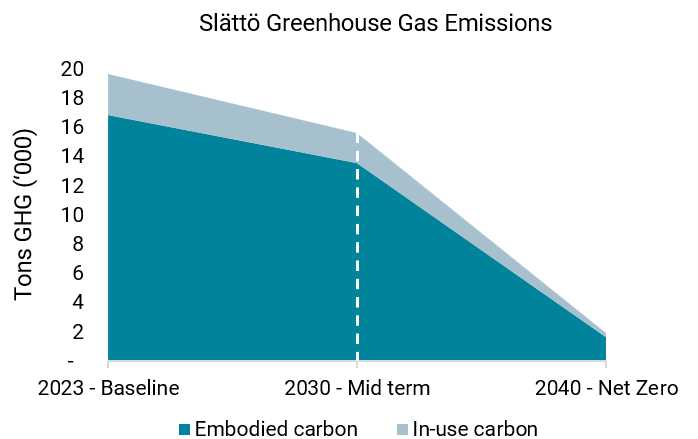
Slättö has a net zero 2040 commitment and has validated its mid-term 2030 targets with SBTi.
Slättö targets a 33% reduction in total in-use carbon emissions and a 19% reduction in total embodied carbon by 2030. On an intensity basis, the targets are steeper: a 70% reduction in CO2 per sqm for in-use carbon and 68% for embodied carbon. The targets include a substantial increase in Slättö's assets under management.
Our approach is pragmatic and action-focused. We reduce in-use carbon by carrying out profitable energy projects, which improve returns. We reduce embodied carbon by requiring cost-effective, low-carbon solutions in project development – thus future-proofing our construction projects.
A science-aligned path matters to investment performance
For in-use carbon, the financial link is direct: Slättö expects emissions reductions to come from profitable energy investments that lower operating costs, increase NOI and improve liquidity at exit.
For embodied carbon, the benefit is more long term: better readiness for regulation, stronger competitiveness and potentially better liquidity for modern-standard low-carbon projects.
- Regulation readiness is a strong driver. Denmark already has strict limits for embodied carbon in new projects. Other EU countries will follow suit as a result of new EU requirements under EPBD.
- The market is already moving in this direction. Most large Nordic real estate developers and investors set embodied carbon limits in projects.
In-use carbon
These emissions come from the operation of buildings, namely energy used for heating, electricity and water.
To reduce in-use emissions, Slättö integrates energy efficiency in its investment strategy and carries out profitable energy efficiency investments, both brown-to-green transitions and optimisation.
Embodied carbon
These are emissions from project development, in particular construction materials and process, that occur before the building is in operation.
Already today there is large potential to cut carbon a minimal cost impact. We include CO2 in tenders and bid assessments, and run early carbon pre-studies. Our focus is on getting general contractors to use cost-efficient, low-carbon solutions, in particular material efficiency, optimised structures, greener concrete and recycled steel.
Slättö's target for embodied carbon in construction is challenging. Part of the target can be reached by using best-available cost-efficient solutions, in particular within concrete and steel. But innovation and faster scaling from the supply chain are required. Just as with other technologies like renewable energy or electric cars, we expect climate-smart solutions to scale and decrease in cost.
To build knowledge about the solutions, Slättö has initiated roundtables with researchers, investors and value chain partners on concrete and other climate-smart solutions. We have held six roundtables so far in 2024-2025. We also participate in academic research on concrete optimisation and circular materials.
Case studies

Slättö has included embodied carbon in the procurement of a large, 655-unit residential project in Bromsten, Stockholm. Slättö is applying CO2 targets in the project, and the first block is expected to reach about 340 kg CO2 per sqm, including all the building parts, at no higher cost. This represents 25% lower carbon than Slättö's 2023 baseline.

In this 40,000 sqm modern logistics development Slättö is building for tenant Stadium, we are estimating embodied carbon of 232 CO2 per sqm. This is a 30% reduction compared to our 2023 baseline, with minimal cost impact. The solutions used are a steel frame with a high share of recycled steel, and foundations and edge beams with climate-improved concrete. Key to success were early-stage climate assessment and an engaged general constructor.

Slättö has invested in the development of a hotel together with one of the Nordics’ largest hospitality groups, Strawberry. The hotel is Strawberry’s first in the concept Stopover. We have decided to use a modular construction in wood, which is cost competitive, suits a hotel project and has lower embodied carbon. The project has a footprint of 255 kg CO2 per sqm including all building parts, and meets the ambitious certification NollCo2.