
Other segments
Hotel and social infrastructure are two niche segments that Slättö prioritises.
Hotels
Resilient, RevPAR-led occupier market and an increasingly international investor base
Investment market
Investor confidence in Nordic hotel real estate remains strong, with 2026 H1 transaction volumes around 14% above the ten-year H1 average, and the market is focused on value-add strategies driven by repositioning, refurbishment and operational optimisation. It is also polarised: new capital is highly selective, concentrating on institutional-quality assets in prime locations while secondary assets and markets attract a narrower buyer universe. Notably, non-Nordic private equity and international operators are testing entry into a market historically difficult for outside capital to enter. Prime yields have come down 25-30 bps from peak in Copenhagen, Stockholm and Oslo, while Helsinki remains unchanged at a higher level.

Occupier market
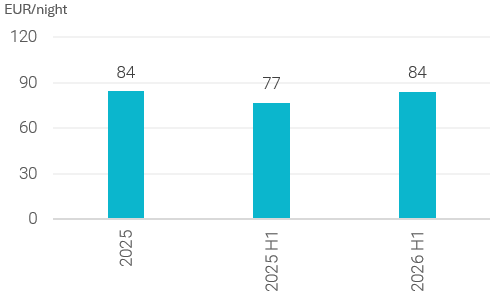
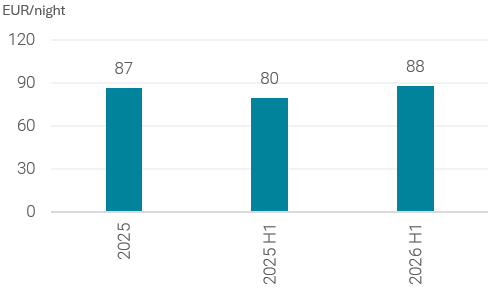
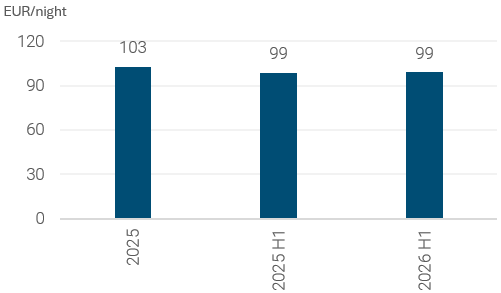
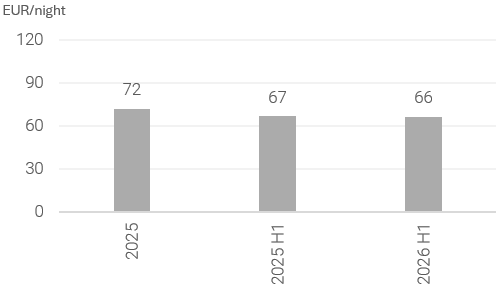
Operating performance remains supportive and the recovery is increasingly RevPAR-driven. In 2026 H1 both Stockholm and Copenhagen were above their year-earlier levels, Oslo remained the strongest absolute performer, and Helsinki was the weakest although increasingly underpinned by record foreign visitation. Summer trading reached record levels, with July accommodation revenue up 12% year-on-year in Sweden and 10% in Stockholm. Growth across the capitals is driven more by room rates than occupancy, so the durability of achieved rates and the risk of new supply are central to underwriting, while rising labour and operating costs weight on profitability and lease-cover ratios. Overall, low new supply and resilient demand support a constructive outlook, with Copenhagen, Oslo and Stockholm in the lead and Helsinki improving from the weakest base.
Hotel demand is attracting more capital, including first international entrants; value-add is the main strategy and prime yields are slowly coming down - Copenhagen, Oslo and Stockholm lead while Helsinki lags.
Operations are supportive and RevPAR-led, but growth is rate-driven rather than occupancy-driven, so rate durability and cost inflation are the key underwriting questions.
RevPAR in Copenhagen
RevPAR in Stockholm
RevPAR in Oslo
RevPAR in Helsinki
Data: Benchmarking Alliance
Social Infrastructure
Selective market, with institutional capital returning to prime assets
Investment market
Transaction activity remains subdued and selective. Demand and pricing have nonetheless risen for modern, high-quality assets with long-lease public-sector tenants - primarily in healthcare, education and security real estate - and the return of institutional capital as active buyers is now the key driver, pushing yields lower including in regional locations. Pricing remains highly polarised: purpose-built assets with strong counterparties on long leases trade at materially tighter yields, while assets with weaker private tenants or greater operational exposure face significantly wider bid-ask spreads. Sweden's outlook is stable with some scope for compression, Norway is relatively active in this segment and has seen the strongest recent compression, Finland has very limited liquidity owing to fund redemptions and healthcare reform, and Denmark remains a small, largely publicly owned market.

Occupier market
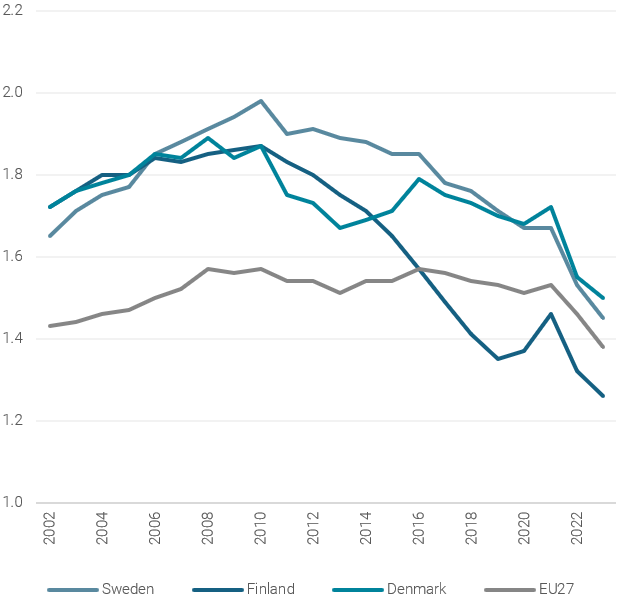
The demand case is anchored in ageing demographics and an ageing building stock, driving sustained need for modern care facilities. At the same time, falling birth rates reduce demand for certain education assets in some regions, increasing the importance of location and tenant quality. Another structural pillar is security and defence: the build-out of total defence (civil and military) and the justice system carries substantial investment needs, with Sweden's NATO membership reshaping where property investment is needed and driving demand across housing, logistics and public services.
Social infra is selective, but institutional capital returning as active buyers is pushing yields lower, with wide pricing gaps between prime assets and assets carrying operational risk.
Ageing demographics support elderly care and senior living, while NATO membership and the defence build-up are creating a new, state-driven demand pillar.
Strong fundamentals for elderly care and senior living
Lower birth rates reduce overall demand for child-related assets
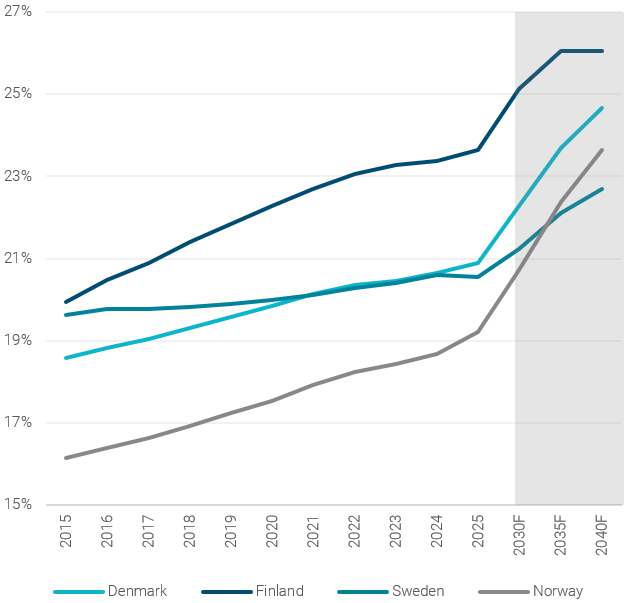
Population 65+ years. Data: Eurostat
Birth rates per woman 2002-2023. Data: Eurostat