
Slättö House View
The Slättö House View is a data-driven market deep dive, updated twice a year. Slättö combines market data, stakeholder input, and internal discussions to form a clear base view of the Nordics and translates it into investment priorities - where to focus, where to be selective, and what to avoid.
Extensive analytical work sits behind the House View, which helps Slättö make better and faster decisions that support strong risk-adjusted returns for its investors.
This is backed by a strong deal flow. Over the last twelve months, Slättö has reviewed 719 deals worth EUR 23 bn in asset value, giving Slättö unparalleled insights on pricing and liquidity.
Here is a summary of Slättö's latest research. To access the complete report, please reach out to the Slättö team: ir@slatto.se.
Nordic market insights
Nordic fundamentals remain strong, with growth accelerating through 2026 and expected to outpace the euro area in 2026-27
Nordic GDP growth accelerated in Q2 2026, well ahead of the euro area, and is projected at around 1.8% in 2026 and 2.0% in 2027. Sweden leads the recovery, and Finland is growing at its fastest pace in several years, reaching 2.5% in Q2 after close to three years of stagnation. Denmark sits at the other end, with growth that can swing with its export-heavy pharmaceutical sector. Real wages are rising faster than the EU average, household savings remain elevated and unemployment is expected to fall in 2026 and 2027, although consumer sentiment has stabilised just below neutral.
Monetary easing, however, has largely run its course. Inflation is normalising towards target across the region - Sweden temporarily sits below target on account of the VAT reduction on food - but the ECB has started a rate-hiking cycle, with the Swedish Riksbank potentially following. Swap rates have risen materially across all tenors over the past six months, which limits the scope for further yield compression even as growth improves. Globally, geopolitical fragmentation, rising public debt and the AI investment cycle keep risk premia structurally higher.
That said, the Nordics are comparatively well positioned to weather this turbulence. The region's structurally low sovereign debt levels and strong credit ratings underpin macro resilience and provide fiscal flexibility in downturns - the Nordics are home to three of only nine sovereigns globally rated AAA, while Finland holds an AA rating. The region also ranks highly in global governance, sustainability and innovation rankings: Sweden, Denmark and Finland rank 1st, 2nd and 4th in the EU Innovation Scoreboard and take the top three spots in the UN's 2025 Sustainable Development Report.
Nordic growth accelerated in Q2 2026 and is expected to outpace the EU in 2026-27.
Monetary easing has ended; rate hikes are increasingly priced in, and swap rates are up over the last six months.
Nordic fiscal strength and governance support investment appeal in uncertain times.
Nordic GDP growth is forecast to strengthen in 2026-27
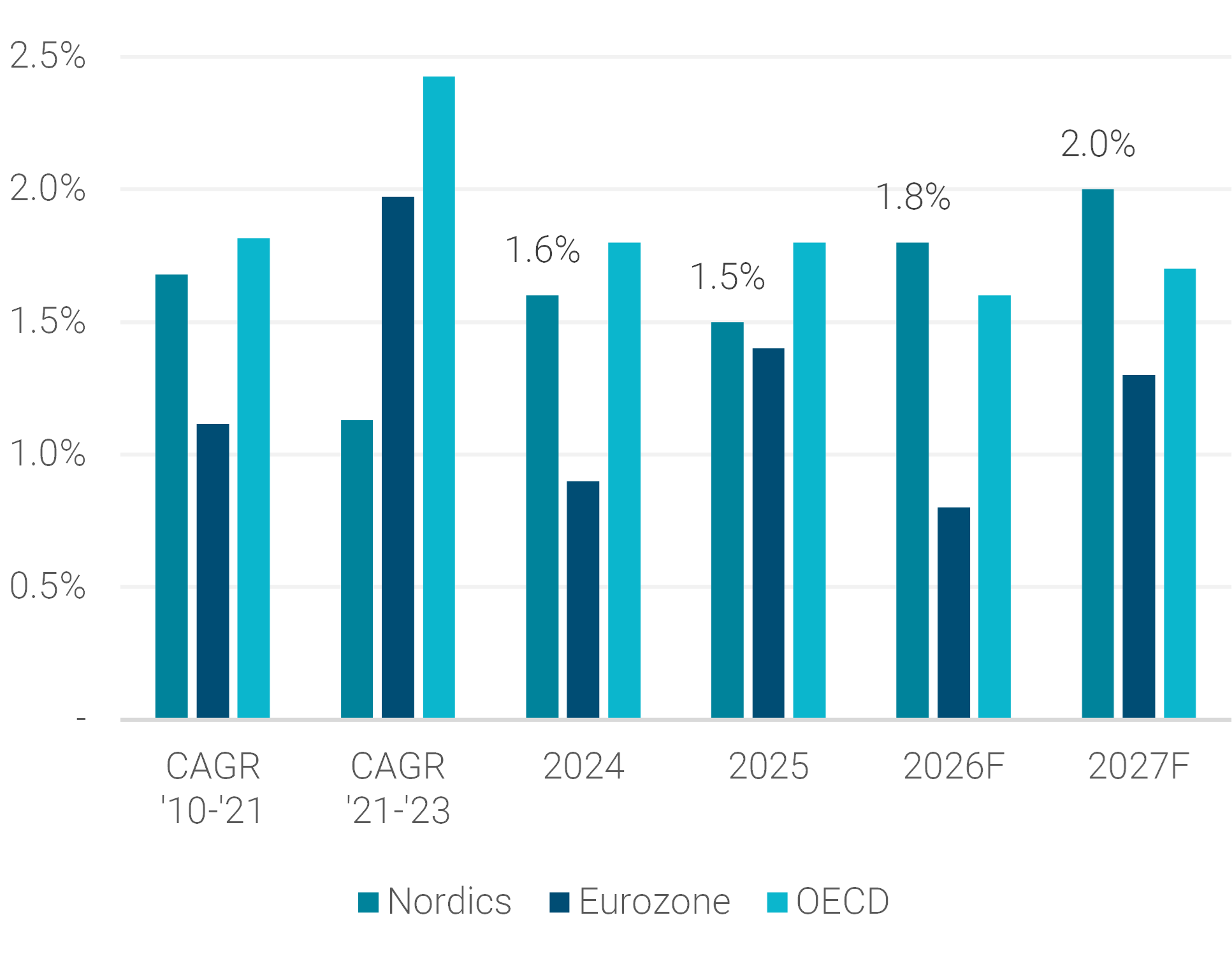
GDP growth forecast. Data: SEB Nordic Outlook May 2026 and OECD
Excellent debt availability in the Nordics supported by stable banks and a strong bond market
Credit sentiment continues to point to good availability. The CREDI Main Index remains at a historically elevated level and the expectations index improved marginally from an already supportive base, with banks foreseeing unchanged margins, availability and tenors, while borrowers are more optimistic and expect further easing. Nordic banks remain stable and profitable with limited real estate credit losses, and strong lending appetite has tightened margins and lifted LTC and LTV levels - though cash flow performance is still the test. Importantly, banks are also being pushed to compete on pricing as mortgage lending stagnates and alternative funding channels reopen.
The Nordic bond market has recovered faster than expected. Issuance rebounded strongly, with 2025-26 volumes among the highest since the 2021 peak, and activity spans the full credit spectrum rather than a narrow flight to quality: both investment-grade and high-yield issuers are accessing the market. Credit spreads tightened again after the spring 2026 sell-off, driven by strong inflows into credit funds, keeping the market open for refinancing and new issuance alike. Total outstanding Nordic real estate bonds amount to EUR 83 bn. Sweden and Norway continue to rely most heavily on bond financing, Finland is more balanced between bank and bond financing, while Denmark remains tied to its domestic realkredit system. ESG has become a gating factor for financing: properties rated below EPC rating E face growing difficulty in obtaining financing, and two-thirds of European lenders will no longer lend without sustainability credentials or a credible improvement plan.
Strong bank and bond market sentiment, with issuance volumes among the highest since 2021 and spreads retightened after the spring shock.
Banks are forced to compete on pricing as the bond market rebounds, while ESG has become a condition of financing.
Office yield spreads remain wider in Sweden, Finland and Denmark
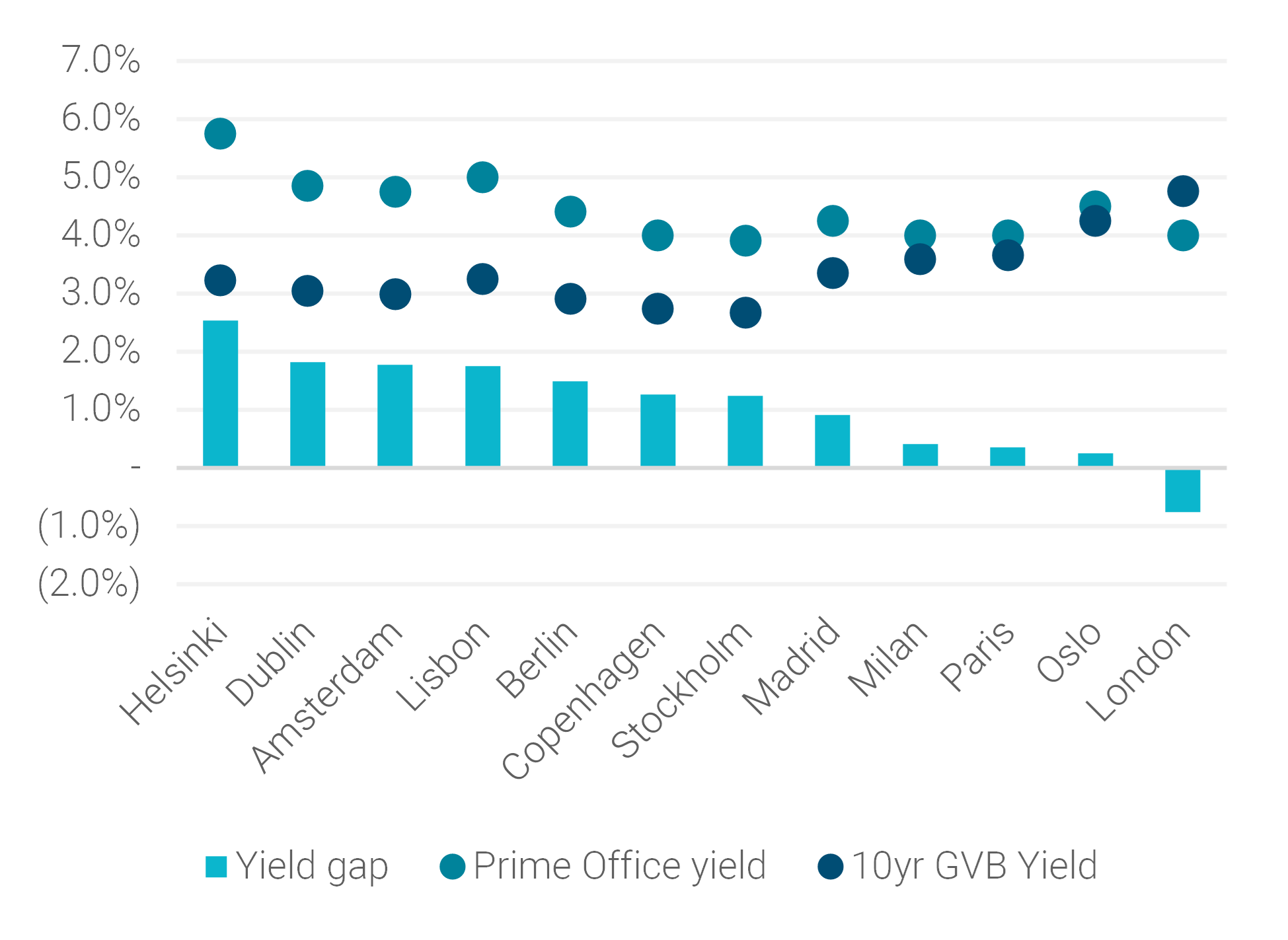
Prime office yields vs. 10yr GVB yields. Data: JLL, Riksbanken, ECB and Norges Bank
The Nordic real estate investment market is now Europe's second largest, with liquidity improving
Nordic transaction volumes have moved ahead of Germany on a rolling 12-month basis to Q2 2026, at EUR 35.3 bn against EUR 32.5 bn. A year earlier the order was reversed, with Germany EUR 5.7 bn ahead, reflecting growth of 39% in Nordic volumes against 4% in Germany. This highlights the Nordics' relative scale and resilience. Liquidity is improving but remains uneven: Sweden is close to a record H1 and Denmark holds its strength, while Finland is rebounding from a low base and Norway shows a pause in momentum. Nordic H1 2026 volumes came in 13% above the 2015-22 H1 average and 85% above the 2023-24 H1 average.
The region also stands apart on returns. Unlike the UK, Ireland, France and Germany, which remain below their 2021 level, the Nordics have moved firmly through the trough into growth on a total return basis. This reinforces Slättö's conviction that occupier fundamentals, not repricing alone, are driving the recovery. Investor sentiment stays aligned with Slättö's prioritised segments: residential, logistics and light industrial and hotels draw the broadest support for sustained or increased exposure, while office remains the outlier, split between resilient prime assets and weaker secondary stock.
The Nordics are now Europe's second largest and among its most liquid real estate markets.
Liquidity is improving, led by Sweden and Denmark, while Finland rebounds from a low base and Norway pauses.
Nordics rank second among major European markets by real estate transaction volume
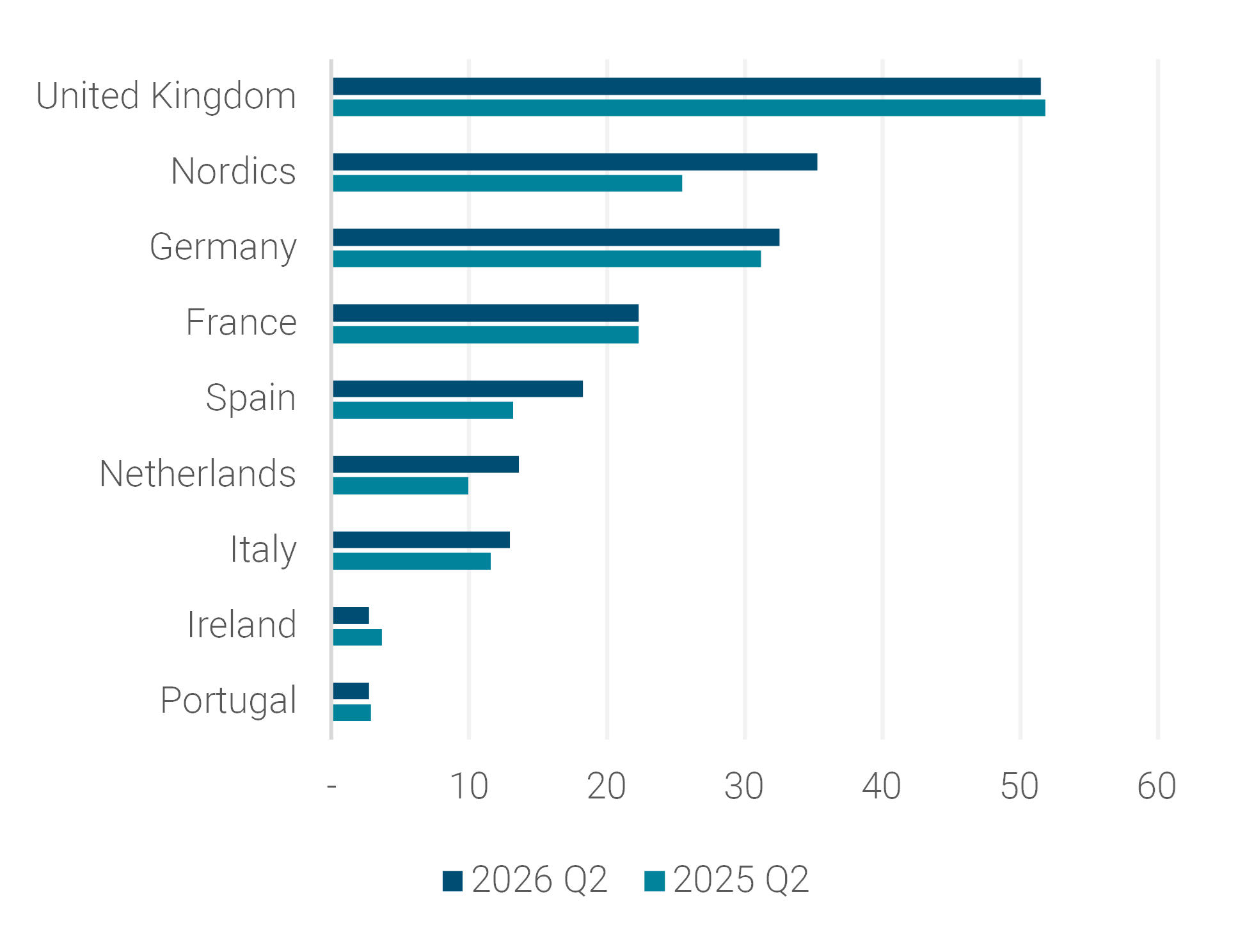
R12M transaction volumes in major European markets. Data: JLL
Nordic yields are levelling out after one of Europe's deepest repricings, with alpha shifting from pricing to execution
The Nordics rank among Europe's most repriced markets, with larger peak-to-trough yield widening than most European peers, and the pricing trough is now largely passed. Nordic yields are stabilising or modestly compressing, led by logistics and light industrial. Denmark is normalising, with the smallest yield expansion of all Nordic markets, though prime residential yields in Copenhagen have compressed significantly. Finland is stabilising or compressing and offers the region's widest yield gap, and therefore the most room to compress as liquidity recovers. Norway is stabilising after significant repricing but remains hampered by high rates and a tight yield gap, with Norges Bank still cutting only gradually, near-term relief is limited.
Slättö's view is that the broad repricing opportunity is fading. Long-term interest rates are expected to rise as markets price in stickier inflation, limiting the scope for meaningful compression, so Slättö expects yields to level out over the next twelve months. Regional cyclical differences still create scope for further capital growth: Finland sits later in its cycle, and a continued liquidity recovery could fuel yield compression given the yield gap still has room to close. Denmark and Sweden are fully priced and Norway offers limited opportunities at current rates. The window nonetheless remains open in pockets of the market and for specialised investors who can create value in fragmented, operationally intensive strategies.
Alpha is shifting from repricing to execution, aggregation and operational performance, with Finland the main contrarian cash-yield opportunity.
Yields are expected to stabilise as interest rates limit further compression
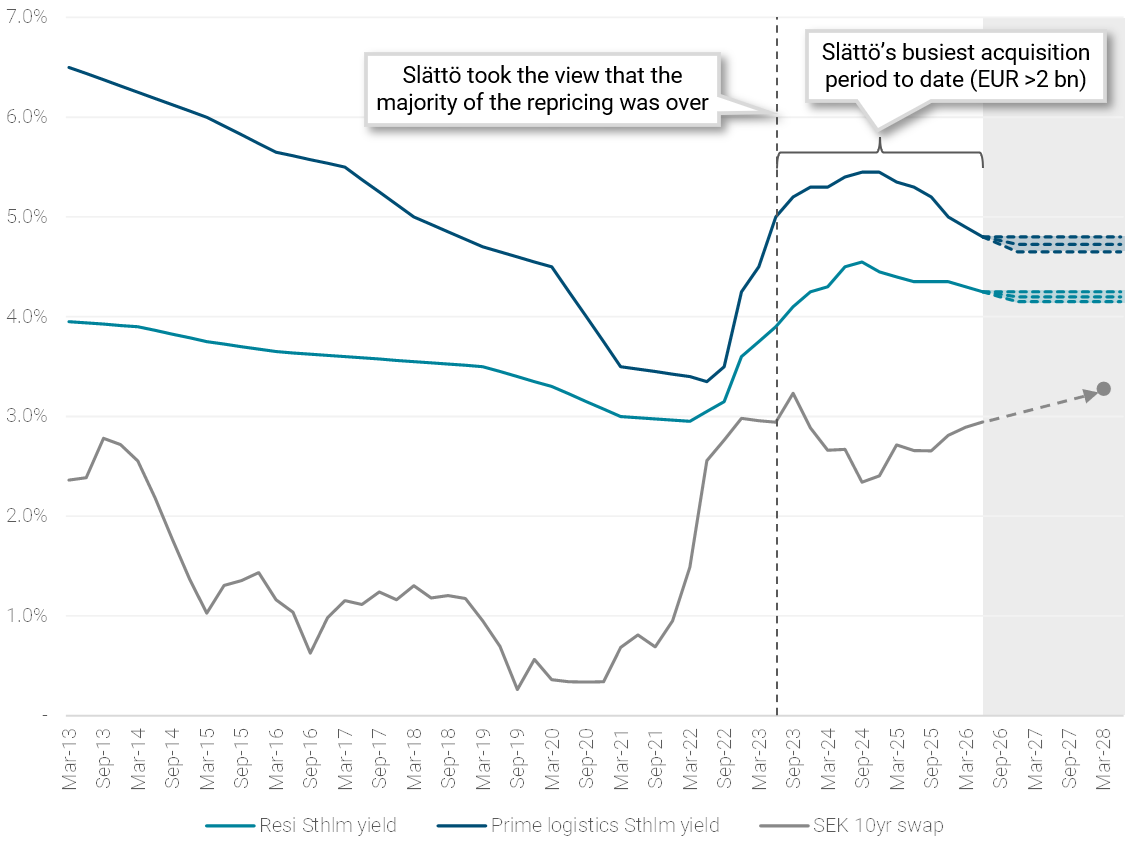
Residential and Logistics yields versus SEK 10yr swap, historical and forecast. Data: Slättö's own forecast, yields from Newsec, swap data from Capital IQ and SEB